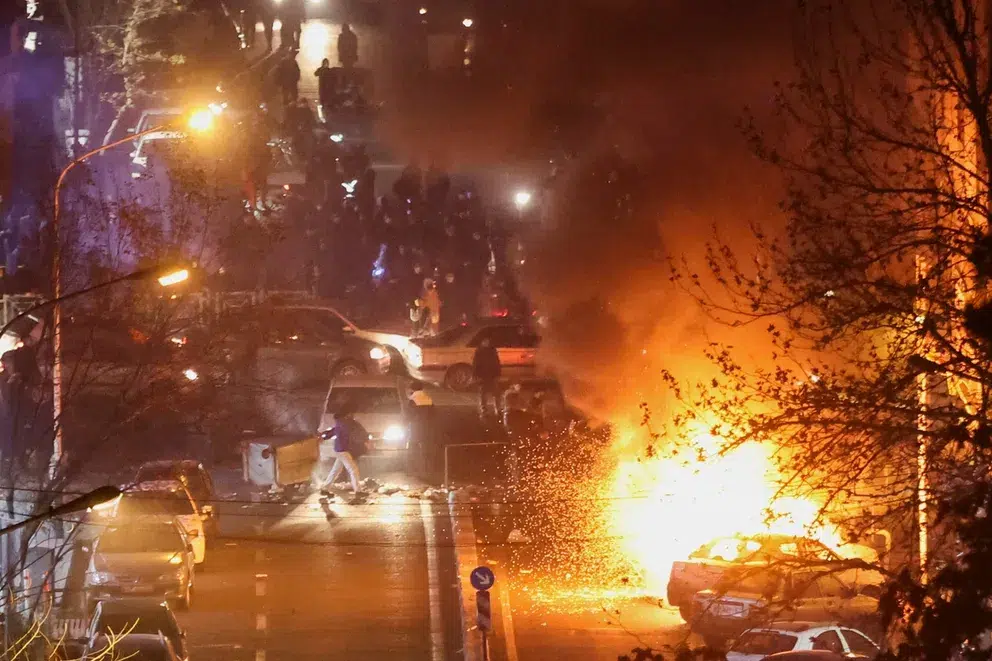
The Iranian authorities' shutdown of the internet in Iran has prevented Iranian Christians from communicating with the outside world in recent days. But we know that some Christians have joined the demonstrations and that a man who is part of the network of donors and improvers supported by the Danish European Mission has been shot. How he is doing now, we don't know. Other Christians have not joined the demonstrations. This is according to a leader in the network of churches in Iran that the Danish European Mission cooperates with.
He continues: “Again and again Christians have said during the demonstrations: Pray for us. The economic situation is very difficult and the cost of living is very high. One man said that his uncle has run out of medicine, for example, so it's very practical that people are feeling the economic crisis.”
Latest US punitive tariffs are a double-edged sword
Trump's latest initiative to impose punitive tariffs on countries that continue to trade with Iran is a double-edged sword. On the one hand, Trump's punitive tariffs are an encouragement to the protesters, but on the other hand, they will hit the poorer sections of the population particularly hard.
The upper middle and upper classes will manage, but Iranians in the lower economic classes will come under tremendous pressure if all countries in the world stop trading with Iran. There could be a shortage of basic necessities, such as medicine.
Will Trump keep his word and attack the protesters?
The big question is what Trump will actually do. Will he really deploy the US military against the clerical regime? So far, he has only threatened to attack if the clerical regime kills protesters. The Iranian opposition media Iran International has reported that at least 12,000 people have been killed in Iran. The question is whether such a high death toll will make Trump live up to his promise.
However, if Trump does not act on his promises, thousands are currently taking to the streets in vain and could become victims of a regime that will not give up willingly, but will kill its own people if necessary to curb the uprising.
The Danish European Mission has received a report that confirms the report from Iran International, where a father in Iran tells his son outside Iran that ‘the situation and conditions are far worse and more serious than what you see in the news and the media - it is as if the cities and people have been attacked in a war. The number of people killed is much higher than what you hear in the news. He said that in order to cut the population off from the outside world, the authorities have not only shut down the internet, but are now going door-to-door and confiscating satellite dishes so people cannot watch foreign news.’
And the question is also what Reza Pahlavi can do. He appears on many media platforms and has called for demonstrations, but he hasn't been in Iran since the 1979 revolution, when his father, Mohammed Reza Pahlavi, was overthrown as Iran's king. Will he be able to rally the opposition, which also consists of communist non-royal groups?
The regime's heavy-handed behavior may encourage more people to seek alternatives to clerical Islam
The regime's heavy-handed struggle for survival and religious rhetoric is causing people to seek alternatives. Iranian Prosecutor General Mohammad Movahedi Azad, for example, has stated that anyone who participates in demonstrations against the Iranian clerical regime will be considered an ‘enemy of God’. Such statements can create a backlash that creates openness towards Christianity, but also other religions.
Since the 1990s, the convert church has also grown considerably, despite persecution, with converts receiving prison sentences of up to 15 years. Before the 1979 revolution, an estimated 500 Muslims had converted to the Christian faith. However, a 2020 poll of Iranians’ attitudes towards religion conducted by the secular Dutch institute Gamaan indicates that 1.5 percent of the population identifies as Christian, or 1.2 million. This figure is far higher than the latest official figure of 117,500 people, which only includes Christian ethnic minorities such as Assyrians and Armenians.
The same study indicated that 8.8 percent and 5.8 percent of the population identified themselves as atheists and agnostics respectively. And furthermore, the study indicated that 59.5 percent of people do not pray, while 27.4 percent pray five times a day.
Additionally, in 2023, a senior Iranian scholar, Mohammad Abolghassem Doulabi, stated according to Radio Free Europe/Radio Liberty that 50,000 out of 75,000 mosques have been closed due to declining attendance. These numbers indicate that Iranians are turning their backs on Islamism and seeking alternatives. The regime's heavy-handed behavior towards the protesters will only accelerate this trend.
Thank you so much for extending a helping hand to spiritual seekers and persecuted Christians in Iran.