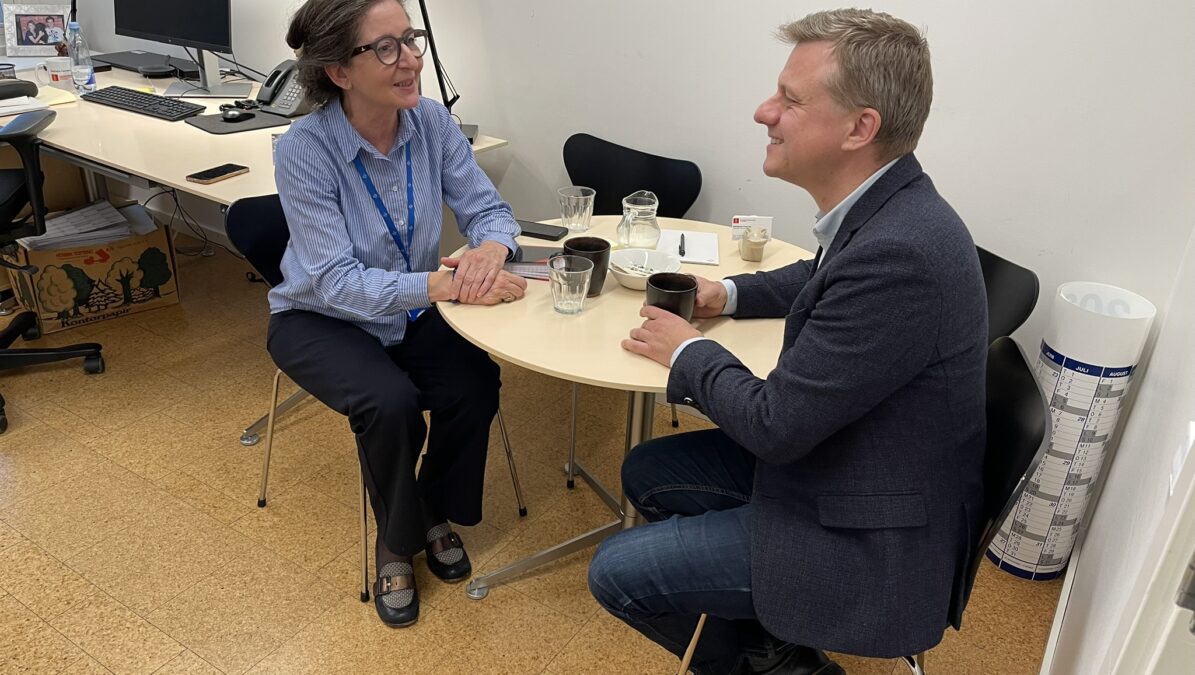
Danmark has appointed a new ambassador and special representative for freedom of belief and religion. And Nathalia Feinberg, who took office last year, has not only extensive but also highly relevant experience to draw upon in this particular role. During her more than 30-year career in the foreign service, Nathalia Feinberg has, among other things, served as Danmark’s ambassador in Kabul when the Taliban seized power in Afghanistan, and under extremely difficult conditions, she had to facilitate the evacuation of staff and others affiliated with Danmark. Nathalia Feinberg has also served as ambassador to Uganda, head of Danmark’s mission to the Palestinian territories and UNRWA, and as a diplomat in Nepal.
“By solving concrete problems, religious tensions can be reduced.”
”When you’re in predominantly Muslim countries, in Nepal—which is predominantly Hindu—and Uganda—which is predominantly Christian—you realize just how important a role faith and religion play, far more so than in Danmark. And thus, you also realize how important the right is to decide for yourself what you believe in. That’s why freedom of belief and religion is quite clearly an important issue. It’s also true that if this right is challenged, it typically has a negative impact on other issues. For example, there might be a conflict at the local level over a well, where religion is brought into play, and access to clean water suddenly becomes part of a religious conflict between two groups. By resolving specific problems, religious tensions can be reduced.”

Nathalia leans forward in her chair and speaks passionately about how Danmark can promote freedom of religion in this complex reality.
”We can promote human rights in various ways. One approach is cooperation within the EU and the UN, including official statements. This can be done through international networks, for example, the International Contact Group for Freedom of Religion or Belief, where ambassadors and special representatives like myself work together and exchange experiences. Then there is development work, where the work for freedom of religion or belief is not isolated, but contributes to building national structures in fragile states, which benefits religious minorities. Furthermore, through the Center for Church-Related Development, we support Danish organizations” projects in civil society with their partners. There are many good activities here, and a potential transformative effect at the local level that builds bridges, prevents conflicts, and creates respect and understanding.”
“We ensure that the situation of convert Christians is included in the dialogue”
”There are many initiatives in Danish foreign policy that are not necessarily labeled as ”freedom of religion,’ but which nevertheless contribute to it. For example, we engage in interfaith dialogue with Indonesia, which is enshrined in Danmark’s bilateral cooperation agreement with that country.”
For Dansk Europamission, working with vulnerable convert Christians is a core task, so I just need to hear if the conditions for convert Christians are included in the interreligious dialogue with the countries. ”Yes, the conditions for convert Christians are included in the dialogue with the countries where it is relevant,” answers Nathalia Feinberg and continues: ”Persecuted Christians and freedom of religion run like a common thread through my work. To achieve this goal, it is important to engage the majority religion and not just zoom in on one minority. Therefore, it is important, for example, to include issues regarding convert Christians, but also atheists, who in some societies are challenged in the same way as convert Christians, in interreligious dialogues and in local projects where it is deemed relevant.”
At the end of the conversation, the ambassador thoughtfully highlights quiet diplomacy: “It has always been important as a diplomat to listen, to have a dialogue, and to understand how to push in a certain direction. This can happen when you're in informal conversations. There are many situations where megaphones don't work, but you can plant some seeds that can sprout.”
Danish Europamission has provided the Ministry of Foreign Affairs with information about the situation in Libya, where, for example, a convert Christian, Dia Balao, was sentenced to death in 2022 for apostasy. The death sentence has not yet been carried out. The Unit for Freedom of Thought and Religion subsequently took up the case.
”It inherently puts pressure on a case like this that we inquire about his case through an embassy, and that’s why we are pleased with the concrete cooperation with you. That we can use each other and take it further through the channels we have. We also raised Dia Balao's case in our international network.”