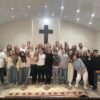
The number of known indigenous convert Christians in Libya is now around 100, and of those, 10 were sentenced to prison on April 15, 2025. The 11th convicted is a Pakistani Christian. The Danish European Mission is following the cases closely and only brings the news now for strategic reasons.
About 12 % of the indigenous convert Christians in Libya are in prison
A total of 12 Christians are serving prison sentences, representing about 12 % of the indigenous convert Christians in Libya. The 12th prisoner is Dia Balao, who was sentenced to death on September 4, 2022 for apostasy from Islam, according to the transcript.
According to the World Religion Database, the total number of Christians in Libya may be over 30,000, but the vast majority are Christian guest workers from countries such as Egypt, the Philippines and sub-Saharan Africa. In some cases, they have churches where they can legally meet.
But indigenous, convert Christians are often more vulnerable. They may be forced to live in isolation from other Christians or, at best, meet with other believers in small underground churches.
However, the convert church is growing in Libya, from around 5 known native convert Christians in the 1990s to around 100 today. "There have not been more indigenous Libyan Christians in recent times than now. At the same time, the persecution is worse than it has been for a long time." So says Ali, as we call him here for security reasons. He leads a team that the Danish European Mission is part of, helping persecuted Christians in Libya and reaching out to spiritual seekers.
Those imprisoned have waited up to two years to be sentenced
And the persecution of Christians in Libya became very clear on April 15, 2025, when 11 Christians were sentenced to prison terms. The sentences have been a long time coming. Two years ago in April 2023, 22 Libyans were arrested for leaving Islam, sharing the Christian message or simply accepting the Christian faith as true. Some were released, but 11 had to wait until April 15, 2025 to be sentenced.
Time and time again, court hearings were canceled, probably in an attempt by the authorities to harass the Christians. Amnesty International has documented that the prosecution violated the defendants' right to a fair trial.
The sentences range from three to 15 years in prison. Ali states: "This move reflects a systematic approach to suppressing human rights and these arbitrary court decisions serve as a tool to intimidate young people and discourage them from thinking independently or challenging traditional norms."
Ali sees the verdict as an attempt to discourage the population from leaving Islam. According to the Arab Barometer poll, the Islamists may have reason to follow the trend of the population turning its back on Islam. According to the Arab Barometer, as many as 24 % of the population in 2021-2022 said they were not religious, which in Libya is the same as saying you are not Muslim. The figure for young Libyans aged 18-29 is even higher.
"Even though a large part of Libyan youth has renounced religion, Islamic militias continue to gain more power", Ali says of the Islamic militias that effectively control a number of authorities, such as various police forces.
Some Christian converts experience resistance in their families
In addition to persecution by the authorities, Christian converts can also face opposition from their families. The reaction varies from family to family. Some families may be open-minded and even accept that a family member has become a Christian, while in other families conflict may arise.
One factor that can trigger conflict in even tolerant families is whether it becomes public knowledge that a family member has become a Christian. Families have to navigate the honor/shame culture and will at least feel some pressure to distance themselves from the family member who has converted.
Through face-to-face meetings and communication via digital platforms, Danish European Mission's intercessors and donors ensure that persecuted Christians can receive pastoral care and counseling in the midst of suffering. In addition, spiritual seekers receive counseling, answers to questions about the Christian faith and faith training. Finally, converted Christians receive help for self-help.