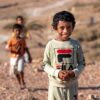
Belal is a 40-year-old farmer, as have benefited greatly from a rainwater collection systemwhich he has received with the support of Danish European Mission donors. On his own land he grows he crops to support his family. He sells the surplus at the market. In this way servant he just over 600 kr. per month. He lives with his pregnant wife, two daughters and a son. His elderly mother also lives with them. As Belal works in the field all day, he has totte his wife Previously fetch the water the family needsvde need - but the well is far from their homes, and as their willr pregnant, willr The trip out there become very difficult for her. Some of the neighboring families havevde a rainwater harvesting system and spatch Therefore for the tripe to the well. I waterthe tank is filtered and is collected the waterso it can be drunk and used for cooking and washing - which, incidentally contributes to prevent corona center. One day, Belal's wife became very frustrated with the situation and moved into her father's house. She told her husband that she would not move back home until he also bought a water tank. If he didn't want that, he would have to divorce her. Belal didn't know what to do. A water tank was so expensive that he would not be able to feed his family for almost two months. He pleaded with God for help.
A short time later, our partner's team arrived in the village and Belal sneezed about the project. While the team number with the village leader, Belal left his farm and hurriedly to meet them. When he arrived, he immediately started telling his story and how his wife would leave him if he didn't get her a water tank. Landsbyens lOaths confirmed Belal words, and the team went to visit him to verify the need for a water tank. Soon the system was installed and Belal was very grateful that his family now could forstay together. His wife returned home and emergency aidthe team narratorthat they were both very happy.
The food basket gave us hope
Najat is another of the manywho have benefited from the relief aid. Hun is married and has three sons and two daughters. She says: "While my husband was working in Saudi Arabia, our lives were stable, even though we were completely dependent on what he sent to us. But when my husband lost his job more than three years ago and went back to Yemen, our life became more difficult. Sometimes he works as a security guard, but his salary is not enough. I help him by going to people's houses and selling clothes, and I save as much as I can to cover our household expenses and the costs of the children and their schooling. Receiving the basket of food meant a lot to us. It represented hope in the midst of a time of price increases and unemployment. We want to thank the one who gave us food.
A big thank you to everyone who contributes to this important project.