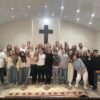
When the Soviet Union collapsed in 1991, new opportunities for mission emerged in the previously closed countries, and many Central Asians encountered the gospel through missionaries and large evangelization campaigns.
Foreign missionaries are expelled

The vast majority of Central Asian Christians have only been saved since 1991, so the church is young. However, the persecution of Christians is increasing and governments - even in countries in Central Asia where the church used to have the best conditions - are now expelling foreign missionaries. Therefore, the young Central Asian church must increasingly learn to stand on its own feet and become responsible.
Teaching at a high level
To strengthen the training of pastors and leaders, the Danish European Mission supports a local initiative in a Central Asian country to train Christians in their own country.
Here, students receive instruction in hermeneutics (interpretation) and biblical languages such as Hebrew and Greek. They learn about the biblical books, including the New and Old Testaments, the Gospels and the Epistles. They are empowered to defend their faith through apolegetics and learn about world religions.
There are also basic theological courses such as bibliology, Christology, the Holy Spirit, anthropology and soteriology. Students are also taught how to grow their faith in their lives through prayer, fasting and keeping the Sabbath. They learn about ethics, pastoral care, evangelism, biblical leadership, pastoral ministry and church planting.
The culture in Central Asia is extremely oppressive towards women and it is normal for men to beat women. This is why the Christian family life course is very important so that Christians can build homes where women are treated with respect and dignity. The subjects are not primarily about doctrinal issues that Christians may view differently. Instead, students with their respective church backgrounds learn methods that they can use to become better teachers and leaders.
New requirements for local academic theological education?
Several church leaders in Central Asia tell Danish European Mission that it is likely that the requirements for approval of churches will be tightened in the near future. One of the requirements may be that pastors must have a locally based theological education, perhaps at bachelor's level.
Reason for claim?
The authorities may in the future no longer allow either Muslims or Christians trained abroad to lead mosques or churches. The reason why the training may have to be local in the future may be that the government does not want Muslim imams to receive extremist training outside Central Asia, for example in Saudi Arabia.
It also affects Christians, and to prepare for a possible future legal requirement, Christians in a Central Asian country have come together to create a locally based theological education program.
Need for solid Bible teaching
Theological education also provides pastors with methods for studying the Bible, which can boost Bible teaching in churches.
A Christian leader in the Central Asian country says that the preaching in some churches has become so practical
in the audience's daily lives that there is a lack of education in what Christians actually believe. And this is where teaching methods of studying the Bible benefits preachers, no matter what denomination they come from.
"There is both cold and hot water here"
Finally, there is a very pragmatic reason why local theological training is beneficial. When churches send their pastors to wealthier countries for training, it is often the case that they have become accustomed to the comforts there and are tempted not to return to the often poor countries they come from.
As one pastor told me, students in wealthier countries experience "both hot and cold water" - as opposed to their home countries where in winter there may only be cold water in the taps, and where it's cold in the small apartments where entire families sometimes live in the same room.
Theological education is thus an important tool for equipping the persecuted church.