By Barbara G. Baker
One year after three Christians were brutally slaughtered for their faith in Malatya, Turkey's tiny Christian community gathered in silence this past week to honor their memory and pray for their grieving families.
Turks Necati Aydin and Ugur Yuksel and German Tilmann Geske were bound, mocked for their faith in Christ, tortured and then slaughtered with knives in Malatya in southeastern Turkey on April 18, 2007. They were murdered in the offices of Zirve Publishing by five young Turkish Muslims who claimed to defend Turkey and Islam against Christian missionaries, leaving behind two widows, five fatherless children and a grieving fiancé.
Memorial services began at noon on Friday, April 18 in a small village cemetery in eastern Turkey. Here, a newly installed tombstone marks Yuksel's grave on the outskirts of the village of Elazig's Son. Yuksel was 32 years old when he was murdered. "He was killed like Jesus," is written at the bottom of the tombstone. On both sides of the monument are the words of one of Yuksel's favorite hymns: "Who have I in heaven but you? And I want nothing on earth but to be with you."
20 of Yuksel's Christian friends attended the short ceremony consisting of hymns, prayers and scripture reading led by Pastor Ahmet Guvener. Yuksel's parents, who are elderly, also attended the service and they screamed as photographers and a film crew from Dogan News Agency videotaped the entire ceremony - they had felt dishonored in the eyes of the local Muslim community when their son became a Christian, and the prospect of their participation in his Christian funeral becoming public made them feel that they would lose even more face.
Another cemetery service took place a few hours later, about 90 kilometers away in Malatya's rarely used Armenian Christian cemetery. Here, German widow Suzanne Geske and her three children, Michel, Lukas and Miriam, joined 35 others in a memorial ceremony for Tilmann Geske, who was murdered at the age of 46. Pastor Ihsan Ozbek of Ankara's Kurtulus Churches led the memorial service, which one attendee told Compass was filled with songs of praise and "a powerful tribute" showing that followers of Christ "do not weep like those who are without hope."
Local gendarmes delayed both ceremonies for almost half an hour by stopping vehicles in and out of Son village. Christians were convinced that the stated purpose - to provide security - was merely an excuse to harass them. After checking the identity papers of all Christian participants in Yuksel's service, soldiers allowed the mourners to drive on. "This was not a routine check, because we drove down a tiny side road into the village," complained one of the Christians who attended both cemetery ceremonies. "It was nothing short of shameful to treat people like this, people who were just on their way to a memorial service. They just wanted to find out who had come to Ugur's memorial service."
On the same day, the Christian publisher Zirve Publishing Co. with whom the three murdered men had had an office, published a traditional black-edged notice in the newspaper Sabah on the occasion of the one-year anniversary of the death of the Christians. "We remember with love and longing those who were mercilessly taken from us a year ago," the note read, listing the names of the three martyrs in large bold type. Aydin and Yuksel were both former Muslims who converted to Christianity. Geske was a German citizen and had lived in Turkey with his family for almost 10 years. "In the hope of our faith, we will be with you again at the side of our Heavenly Father," the note ended. "We have not forgotten you."
Large turnout in Istanbul
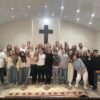
On Sunday, April 20, a national memorial service in Istanbul drew over 900 Christians from across Turkey to commemorate the lives and violent deaths of the three Christians. The crowd flooded the spacious sanctuary and spread to the courtyard, forming a ring of onlookers on the balcony.
Semse Aydin and Suzanne Geske sat side by side in the front row of Istanbul's St. Esprit Catholic Cathedral during the 90-minute service, accompanied by their five children. They were flanked by priests representing the local Orthodox and Catholic communities, foreign diplomats and several lawyers representing them in the murder case against the five arrested suspects. Immediately behind them sat Armenian Christian widow Rakel Dink, who had come to pay her respects to the Malatya victims and to meet their families. Her well-known husband, journalist Hrant Dink, was murdered in Istanbul three months before the Malatya murders.
Both widows spoke briefly to the crowd, sharing the difficulties they had faced after the loss of their husbands and the encouragement and hope they had found through God's promises and fellow Christians. "Every single day without Necati for the past year has been a bitter cup to drink for me," said Aydin. "I'm sure it has been the same for Suzanne and for Ugur's fiancée." Geske quoted the Turkish words she wanted on her husband's tombstone: "He came to serve the people of Malatya, but unfortunately the people he came to serve killed him."
Tears rolled down the cheeks of 6-year-old Esther Aydin and 9-year-old Miriam Geske as a 15-minute photo collage of their fathers and "Uncle Ugur" was shown on a large screen alongside footage of the murdered men singing and testifying.
Turkish officials were missing
The invited Turkish government officials and local media were conspicuous by their absence. According to the organizing committee of the memorial service, which was sponsored by the Alliance of Turkish Protestant Churches, formal invitations had been sent to both government officials and the Turkish press.
Except for the newspaper Cumhuriyet and the English language Turkish Daily News Turkish media did not mention the commemoration ceremony for the Malatya murders in Istanbul. However, in the closing speech of the afternoon, the President of the Alliance of Turkish Protestant Churches directly addressed the significance of "this relentless massacre" for Turkey. Explaining that both individuals and society make conscious choices, Pastor Zekai Tanyar of Izmir begged the leaders who govern Turkey to "face the realities" taught in Christian scripture. "He who sows death cannot reap life. He who sows evil cannot reap goodness. He who sows curses cannot reap blessing," he emphasized. "I knew Necati, Ugur and Tilmann, and especially Necati very well," said Tanyar. "I laugh bitterly when I hear the unscrupulous lies about them. The only crime my three brothers committed was believing in God, following Jesus and telling people about God's message of love and hope for them."
Tanyar spoke against the common mentality that says: "to be Turkish is to be Muslim." "Give permission to my faith and let the Creator be the judge!" Tanyar pleaded. "My heart loves my country and my Lord, and no gossip, anti-propaganda, pressure or politicians can change that!"
Turkish Protestants have compiled a list of 19 incidents of violence against their community of less than 4,000 over the past year. When the memorial service was over, dozens of participants streamed down the church's side aisles to lay long red roses and flickering candles before the cathedral's altar.
A special edition of the Turkish Christian magazine Gercege Dogru (Towards the truth), dedicated to the Malatya martyrs, was handed out to churchgoers in the courtyard of the cathedral along with a newly published book of Necati Aydin poetry entitled My name is inscribed in heaven.
A third cemetery memorial service will be held by Turkish widow Semse Aydin and her children Elisha and Esther in the Aegean city of Izmir, where Necati Aydin was buried just weeks before her 36th birthday. (Source: Compass Direct News)